By D. Rotch
Prologue
Summer, 1999: The flight was 5 hours long. By the time the rental car was ready, late afternoon hung in the air. We stopped at Manuel’s for food and drink before heading to our destination; a vintage hunting cottage in the lake settlement of Pine Lake.
In the morning, after breakfast, I stepped outside and walked past the tennis court to the lake trail. Across the lake, the beach house, a swing, a slide and a basketball quarter court. On the creek side there was a patch in the earthen dam; probably from a lake dredging. About mid-walk, a man was sitting on a park bench over looking the lake. We exchanged greetings. A few steps later I passed two policeman on foot patrol. As I approached the end of the trail there was a person looking back down the trail. I turned and looked. The two policeman were talking to the man who was sitting on the bench.
I asked the resident: “What’s going on?”
The resident replied: “We haven’t seen him here before”.
I was astonished, I asked, “Are the police going to want to talk to me? You haven't seen me here, before.”
The police did not want to talk to me; the police wanted to talk to the black man, sitting on a Public Park bench.
Private Park
A year after our visit, year 2000, we moved to Pine Lake because there is a lake. We were told that the park is private. Along with many other residents we simply did not believe a City, an agency of the State, could have a “Private Park”. Amongst the town’s Public Officers and the Association of Involved Neighbors, PLAIN, the Park Card was enforced and endorsed.
I recall the day Linda came home from the park after being accosted by a Pine Lake Police Officer, who demanded that she produce a Park Card or leave the park. Linda, among other law abiding citizens, were ordered out of the park by Pine Lake's police. Linda complained about the episode and was told that the “Police are doing their job.”
I went to the city Clerk and asked for all the information the City had on the so called Park Card. The Clerk handed me one sheet of paper, the Park Card application form, which prominently stated that the police enforce the Park Card. I asked for a copy of the Park Card Ordinance. The Clerk said, “There is no Park Card Ordinance.” Since police are sworn to enforce Ordinances and Laws; ergo, the police were not doing their job. In fact, the Pine Lake Police were ‘acting under color of law’; there by, violating Civil and Constitutional Rights.
Historic Charter
During this period I had a number of email exchanges and conversations with Council and Mayor (Public Officers) who attempted to school me regarding the legitimacy of the Park Card. A Mayor wrote
‘Please read the historic records on the lake’, wrote the Mayor.
The historic records refers to what is known as the Lake Foundation; a group of investors who financed the infrastructure and wrote the charter for what was to become the City of Pine Lake. At that time, circa 1935, segregation was enforced under the rubric of the ‘Separate but Equal’ Supreme Court ruling.
The Pine Lake Park Card was a “Jim Crow Law”, also known as, “Covenants and Restrictions,” that proliferated after the Civil War, circa 1865, and were stricken from use by Civil Rights Legislation by 1968. For 100 years segregationist era laws led to the persecution and prosecution of African Americans, enabling toxic privilege. Those who attempted to defy, “Jim Crow” restrictions, often faced arrest, fines, jail sentences, violence and death.
The Lake Foundation’s relevance ended with the advent of Civil Rights Law, circa1965. I cannot stress this enough ”Jim Crow”, an instrument of ruthless discrimination, rooted in segregationist ideology, was embraced by the City’s Public Officers and the Association of Involved Neighbors, who masquerade as leadership and suffer from the delusional exuberance of privilege.
The extent that Pine Lake’s Public Officers went to legitimize, ‘’Jim Crow,’’ is revealing, with hints of influential players condoning or at least aware of the deception. In a 1992 AJC interview, the Mayor, said Pine Lake can make the Park “private” because it is not a County Park; however, all Public Parks are held by the State for Public use. Why the AJC did not push back on the Mayor’s assertion, that the Park is private, is troubling.
Additionally, a man described as a neighbor of the State Representative, was accosted by Pine Lake Police and cited for not having a Park Card. (Remember, there is no Park Card Ordinance) The man challenged the citation in the Pine Lake Court. The Court upheld the citation. The man did not appeal the case. The case appears to be a set up to provide a cover for “Jim Crow.” A Mayor wrote:
“Our elected officials know as well as the state departments. Because the lake, beach house, and the city hall (the old church) is only entrusted to the city under certain circumstances and because those circumstances were upheld when challenged in court, we must (by court order) continue to operate under the requirements of the Foundation. We have the courts decision at city hall.”
The Pine Lake Court over turned Landmark Civil Rights Legislation; one is left in wonder at this detachment from reality that went on for 20 years.
Next: No Apology
by D.Rotch
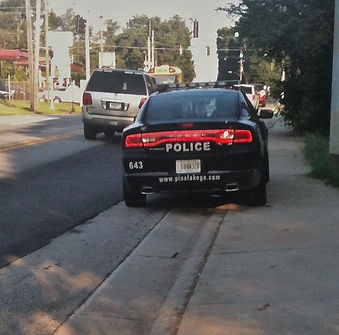
The activity of the Pine Lake Police on Rockbridge Road is questionable. The two lane Road runs from Scottsdale to State highway 124 (9 Miles ). There is no parking allowed anywhere on Rockbridge Road. The Road has no ‘shoulders’. One can safely say that parking on Rockbridge Road creates a hazard, that is why it is illegal to park on Rockbridge Road.
The Pine Lake Police have the undisputed right to patrol the approximate 2000 foot jurisdiction corridor on Rockbridge Road; however, patrolling the Road does not produce enough revenue to keep the citation mill viable.
The Pine Lake Police resort to a ‘Lay and Wait’ strategy, breaking the law, in order to facilitate the issuance of citations. The Pine Lake Police park on the road, the sidewalk and on private property, without the permission of the property owners. The City's Council's ‘cash cow’ mentality is deliberately causing hazardous conditions on Rockbridge Road, placing the Public and the Police Officers at risk. The risk is underlined by the death of Pine Lake Police Officer Manuel Ortega.
In the United States Code, the term “color of law” describes and defines an action that has either a "mere semblance of legal right", or the "pretense of right", or the "appearance of right", which adjusts and colors the law to the circumstance, while the apparently legal action is itself illegal. Source: Wikipedia
The destabilization of the Lake Trail Bank, lays bare the systemic, cyclical disfunction of the governing body.
The City’s function, in relation to the Public Park, is to do routine maintenance. The City does not own the lake or the park. All Public Parks are held by the State for Public use.
During the Greg Zarus administration the City garnered grant funds from Federal, State and Dekalb County sources. The funds were used to repair the failing creekside dam, and to dredge the lake and build a stable, permeable trail surface, along with other major improvements. These improvements were made by the Army Core of Engineers. Removing ACE improvements may be illegal. Has a crime been committed here?
.
The governing body’s degradation of Public Property is vandalism*. The cost of undoing the damage and re-establishing the Lake Trail Bank will be many thousands of dollars.
The native Hibiscus plants, that were removed, were essential to keeping erosion from undermining the Lake Side Pathway. The erosion preventing Hibiscus are gone. What has happened is a brutal senseless act of vandalism’.
We are the victims of a governing body, that in all respects, is ‘acting under color of law’. The City’s governing body is masquerading as a legal authority. This situation requires accountability and removal of the City Charter. The City of Pine Lake’s brand is toxic.
* “Vandalism can carry serious criminal consequences, including felony charges that may result in prison time, heavy fines…..